
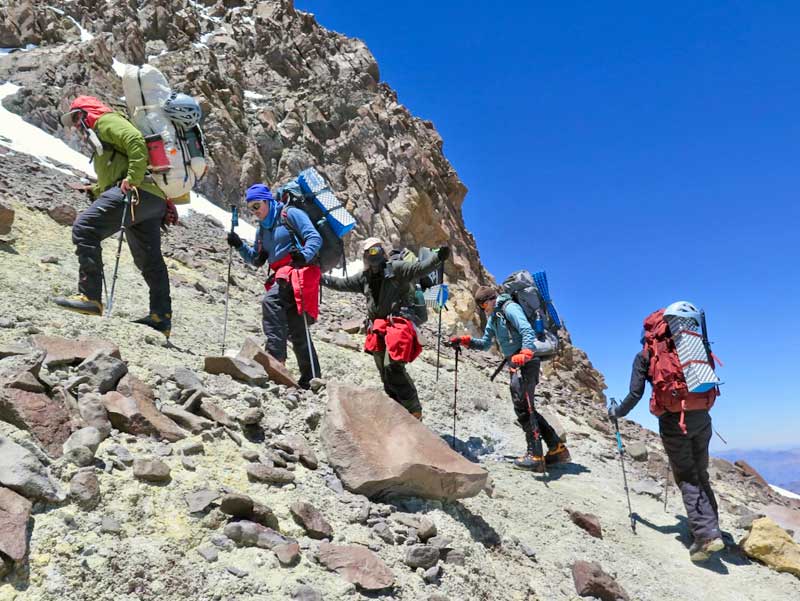
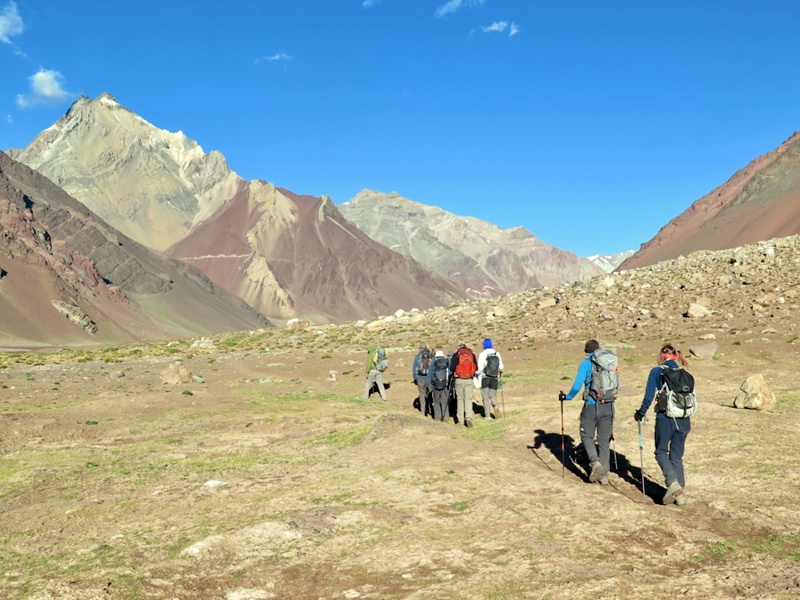
At 6,962m Aconcagua is the highest mountain in the world outside the Himalaya. Yet it is often considered an 'easy' mountain and it's difficulties underestimated. I must hold up my hands and confess that this year I set out for a sunny holiday in the wine country of Mendoza and assumed that the little detail of climbing the mountain would be straightforward. I got a rude awakening on a long and very tough summit day.
Everything had started very well. I arrived in Mendoza a week before the group, hired a bike and did a few 100km plus cycle trips in the warm Andean sunshine. On my rest days I enjoyed excellent tasting tours of the local vineyards and wineries. When the climbing team were all in town we were whisked swiftly into the mountains following the route of the defunct trans Andean railway built in 1910 to link Argentina and Chile. Although the line was closed in 1984 whenever I see the narrow gauge tracks cutting through the impossible mountain terrain I imagine it reopened as one of the most scenic rail journeys in the world.
This was not my first time in the region. I had climbed Aconcagua three times before. In 1994 and 1999 from the Horcones valley, and in 2001 from the Vacas valley. Most memorably spending the night of 31/12/1999 at Nido de Condores (Camp 2) on the regular route, and becoming one of the first parties to summit in the new Millennium. I had memories of good food in Basecamp, long scree slopes, and climbing that was not too hard.
My early trips to the mountain were facilitated by the oldest of the Aconcagua outfitters and I had dealt with the legendary founder of the company, Fernando Grajales. Fernando Sr died in 2004 and the company is now run by his son Fernando Jr who I had met on Everest many years ago. The mountain is situated in a Provincial Park with strict environmental protections. The outfitters work together with the park to ensure that the growing numbers of climbers have a minimal environment impact despite the increasing size and comfort of Basecamp.
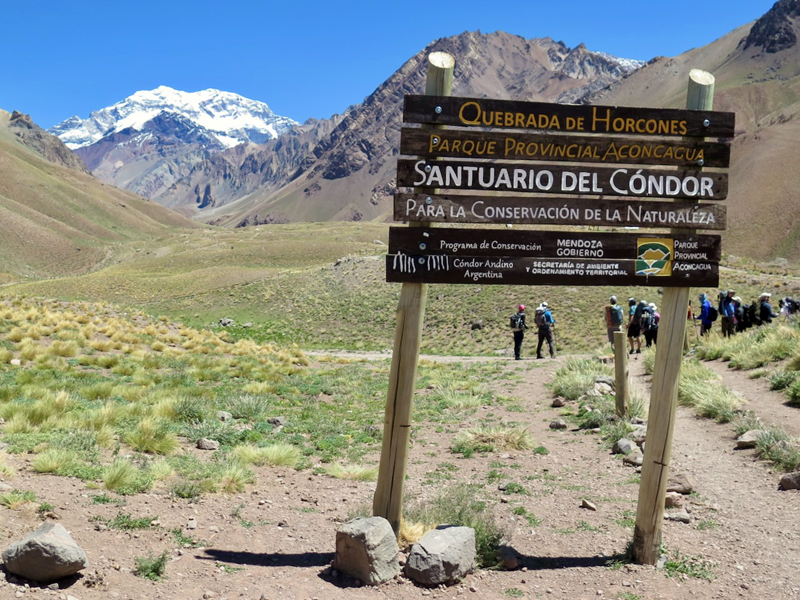
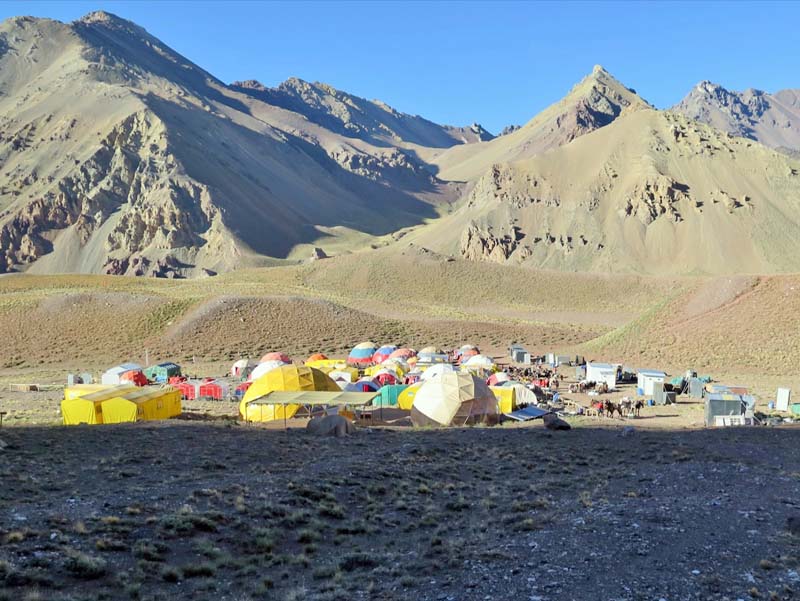
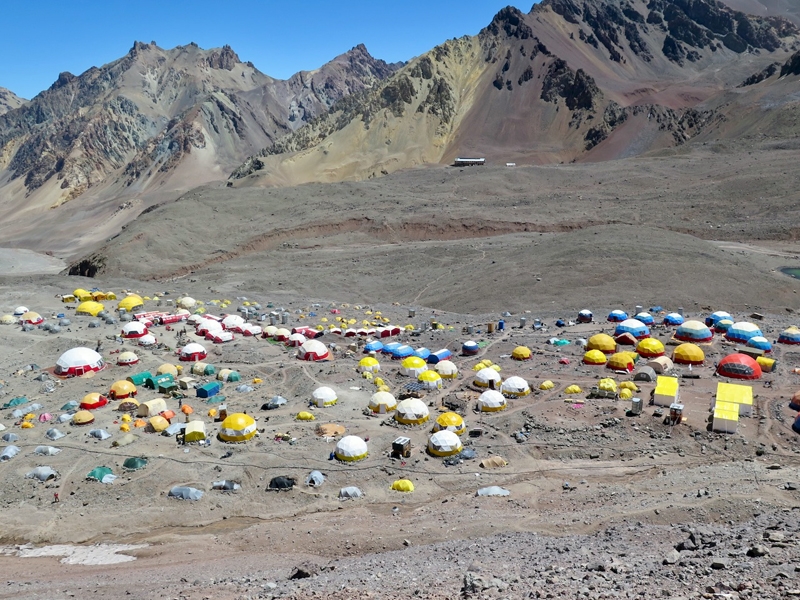
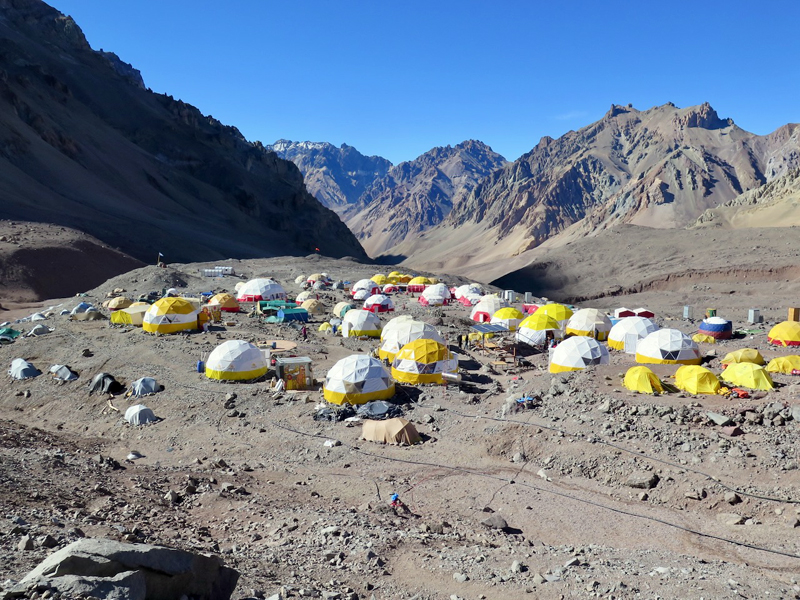
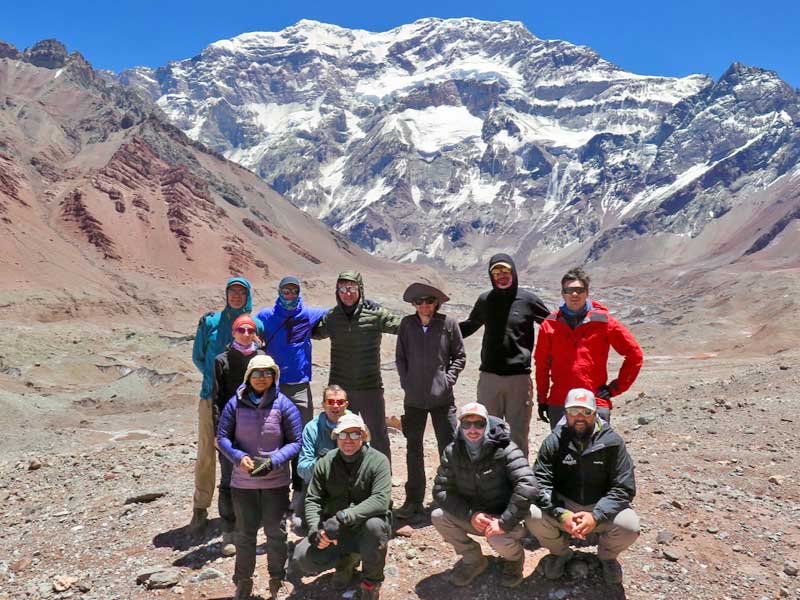
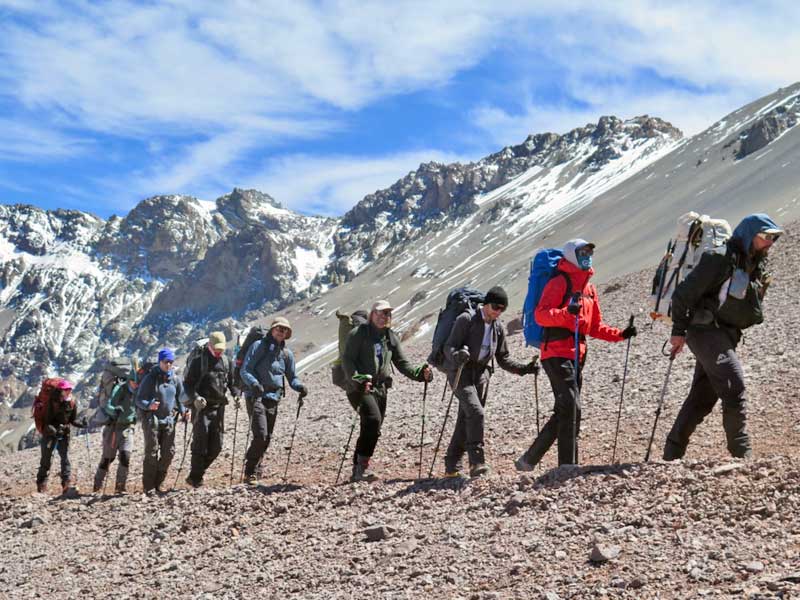
We left the valley of the modern road and the old railway, entering the Park at an altitude of 2880m. Over the next four days we made our way slowly to the Plaza de Mulas Basecamp at 4365m. The hike could be done over two days but given the height gain this would not be advisable. So we spent three nights at the intermediate camp, enjoying a strenuous hike to the foot of Aconcagua's impressive South Face and a relaxing rest day. When we finally made it to Plaza de Mulas were were greeted by the sight of probably the world's most impressive seasonal mountaineering Basecamp, complete with hundreds of tents of all sizes, shapes and colours.
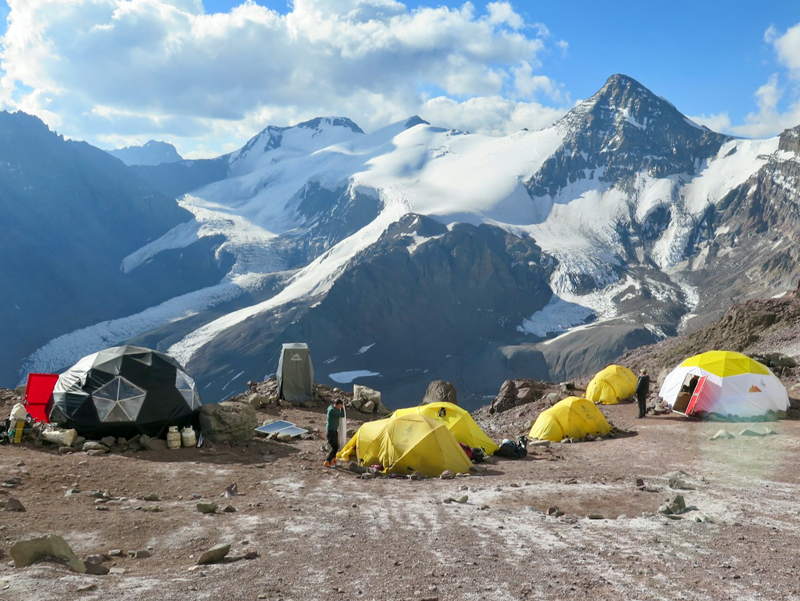
This was to be our home for the next five days while we completed the next phase of acclimatisation and carried some loads of personal equipment to the higher camps on the mountain. The weather was mostly clear and sunny every day, with occasional afternoon clouds. At the lower altitudes of the approach walk temperatures can be unpleasantly hot in the absence of a cooling breeze. At Basecamp the temperatures were cold at night and warm in the day, but a cold breeze could arrive unexpectedly sending everyone scurrying to find warm hats and jackets.
The catering at Basecamp lived up to expectations with large portions of hearty Argentinean food (featuring a lot of steak) and the local Malbec wine. We carried lights loads up to Camp 1 and hiked to the 5,004m summit of Bonete Pk for fine views of the full route up Aconcagua. Climbing a mountain of almost 7,000m in three weeks from the UK is always going to be tough, especially when three full days are taken up with international and domestic flights. We were hoping for as many days of acclimatisation as possible leading to a summit attempt on January 6th or 7th. But the weather forecast was looking ominous with winds over 100 km/h starting on the 5th and continuing for a few days. It seemed that our only chance to climb to the top would be on January 4th, while we should still be load carrying and acclimatising.
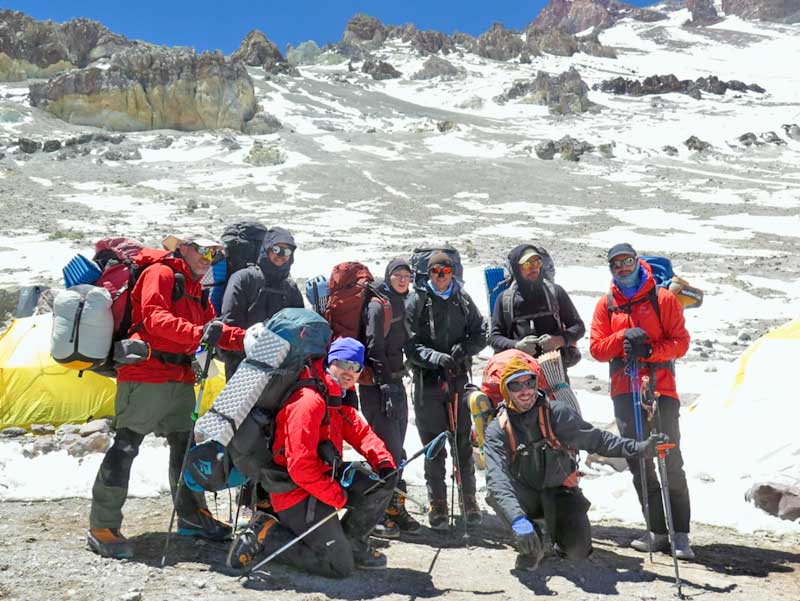
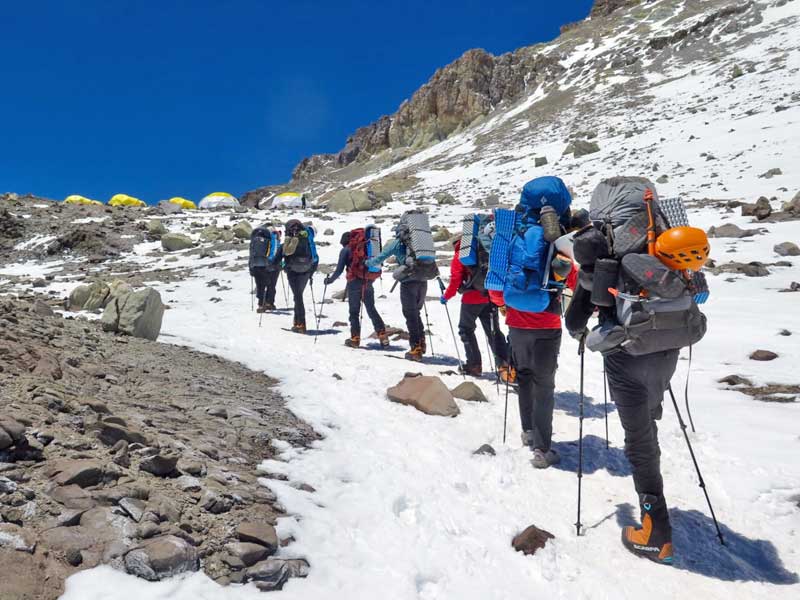
We consulted with our team of three Argentinean guides (Leandro, Juan & Leo) and came up with a revised plan. We would forego one of the load carries from Camp 1 to Camp 2, squeeze in a rest day at Camp 2 on January 2nd, and climb to Camp 3 on January 3rd. One thing that does make Aconcagua more straightforward than comparable 7,000m peaks in the Himalaya is that the route from Basecamp to Camp 3 is normally free of snow during the climbing season. So progress can be fast, and none of the climbs between each of the camps should take more than 3-4 hours. This is perhaps why it can sometimes misleadingly be called an 'easy' peak.
The sting in the tail is that summit day is much, much harder than anything that has gone before. More acclimatisation days before the final ascent can help a bit, but it is still a long hard 1000m climb from Camp 3 to the top.
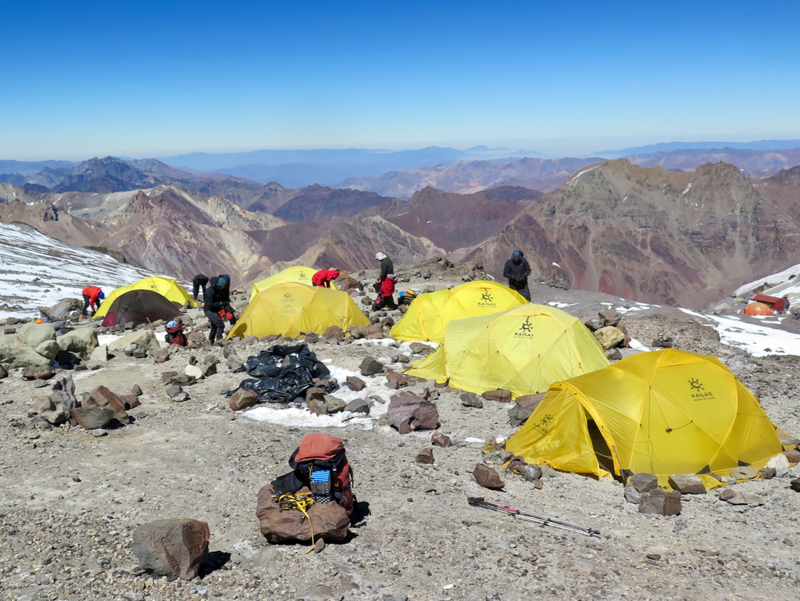
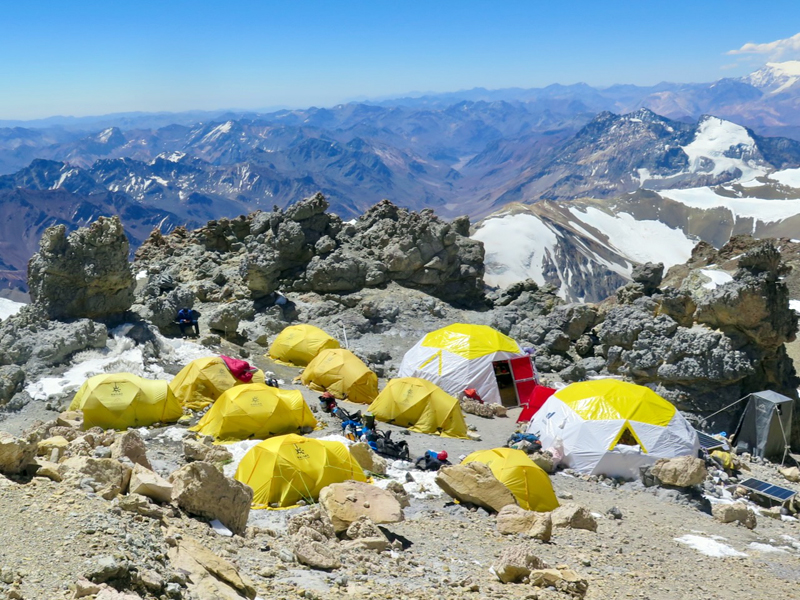
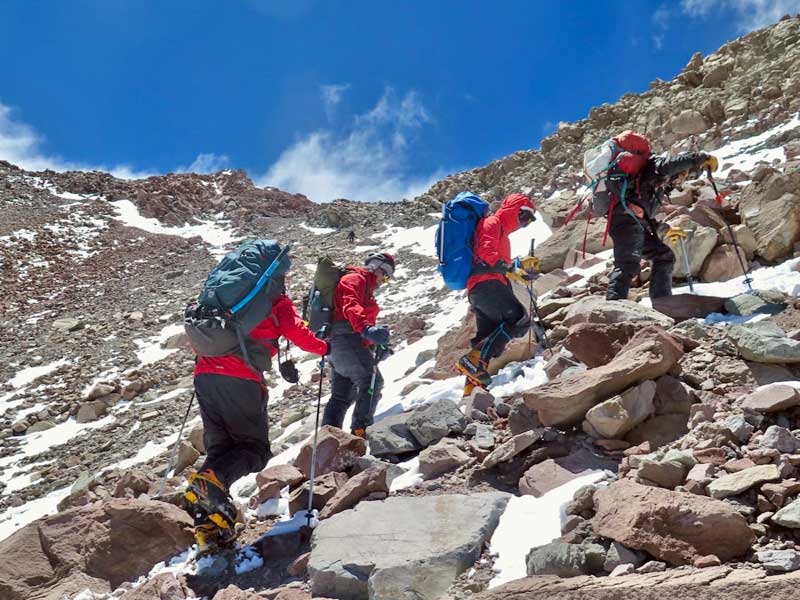
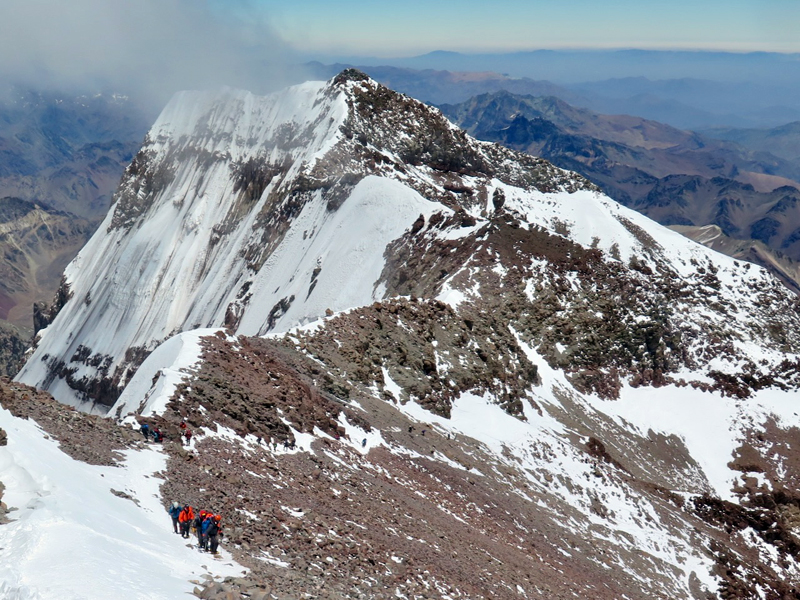
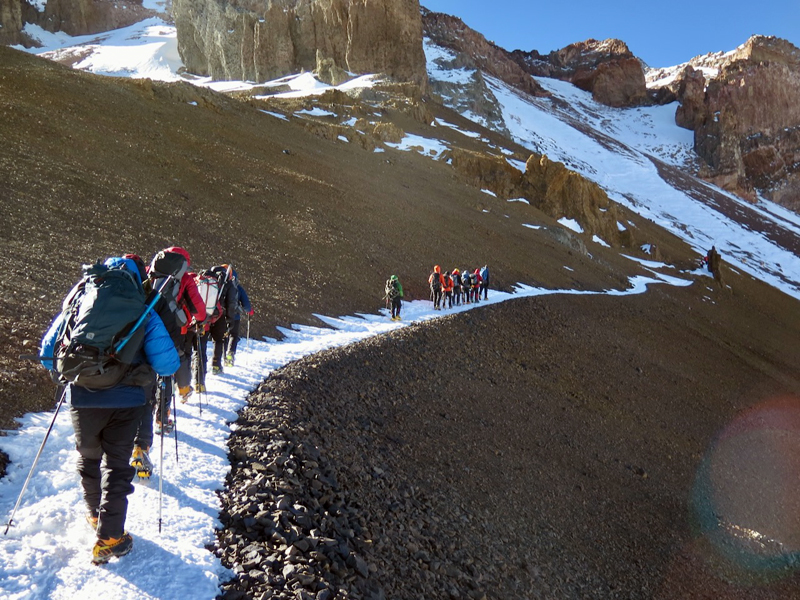
We left Camp 3 at 05.00. Two of the team chose not to join the summit party, so we were a team of six climbers and four guides. This was the first time on the ascent that we climbed in the hours of darkness, as we followed a faint path up the rocky slope illuminated by the glow from multiple headlamps. The route to the top can be divided into three distinct sections punctuated by two obvious resting places. The first of these features is a flat area marked by the ruined emergency shelter called Independencia. We reached this almost three hours into the climb, just in time to see a spectacular sunrise over the surrounding mountains.
After a brief rest in the sun's warming rays we moved back into the shade for the coldest part of the climb, a long traverse along a narrow ribbon of snow followed by a steepening snowfield leading to the second major feature, the cave. It would take almost three hours to complete this section, and part way though one member of the team decided to turn back to Camp 3 with Leo the youngest of our Argentinean guides. I have been told that snow on the slopes below the cave is easier to climb than exposed scree, so we should count ourselves fortunate. But it did not feel easy. It just felt really hard and I found myself needing a rest stop after every few steps. The lead group of Juan, myself and four climbers reached the cave feeling a bit cold and took a thirty minute break to eat, drink, and warm up.
Leaving the cave we moved onto the slope called the Canaleta leading up to the summit ridge a few hundred meters above. We could see Leandro with the remaining member of our team a little below and making steady progress. The change of slope aspect and the rising sun brought a welcome increase in temperatures and we started to feel pleasantly warm for the first time on the climb.
The Canaleta has a fearsome reputation as a steep scree slope where each two steps up are accompanied by a dispiriting one step sliding back down. However a narrow ribbon of firm snow at the right hand edge of the slope enabled better footholds and we made efficient if slow progress. After so many hours of constant uphill climbing we were hoping that the final section of the ascent, the Guanaco Ridge, would be a bit more horizontal. The angle eased a little, but there was still more than 100m of height to be gained from the top of the Canaleta to the true summit.
As I laboured to put one foot in front of the other I could not honestly think of the last time that I had felt so tired and short of energy on a mountain. I kept asking myself 'was it his hard last time I was here? and if so why didn't I remember it like this?' My recurring thought was 'If I had known it was going to be this hard I would have gone somewhere else and climbed something easier instead!'
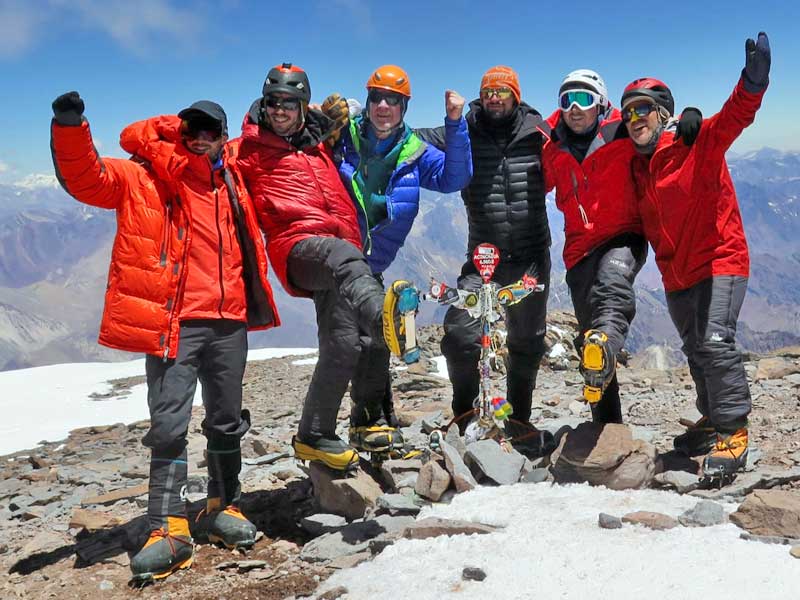
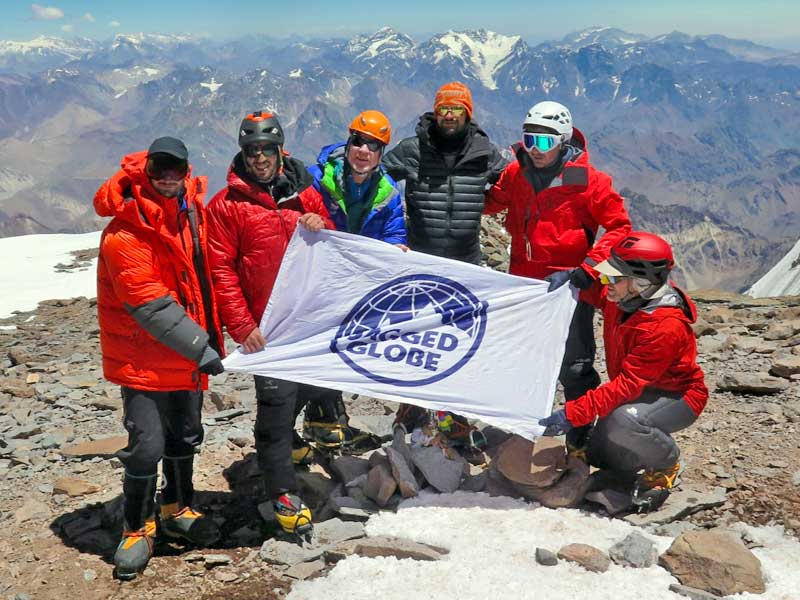
The summit was not far above. A few climbers ahead of us had already reached the top and were walking around, silhouetted against the skyline. The figures gave a scale to the features of rock and ice. We realised that after nine and a half hours of effort we had only keep going for a few minutes and climb the final few metres to reach the top. A small metal cross stood in the middle of flat area the size of a tennis court. There was plenty of space to remove backpacks and enjoy a seated rest, before struggling onto our feet again for the obligatory summit pictures.
After about twenty minutes we got ready to start our descent. As we looked down we were all pleased to see the final members of our summit team approaching. Leandro with our fifth climber were about thirty minutes below the summit. Descending, we were with them in less than five minutes. Then a strange scene unfolded unlike anything I have seen before on a big mountain. Our Argentinean guides (Leandro and Juan) were in conversation with two members of the Park Ranger (Mountain Rescue) team. Apparently on busy days when there are several parties high on the mountain they conduct a sweep ensuring that slow climbers don't get stranded on the mountain. In theory this sounds quite a sensible safety procedure. The hard question is: where to set the cut off point? It was only 15.15 in the afternoon and our climber was confident that he could climb the final section of the route to the top with enough energy in reserve to make a safe descent. The fact that there had already been an accident on the mountain earlier in the day may have served to make the authorities extra cautious. It did not seem sensible to contest their well intentioned decision and we all agreed to descend.
Some of our team who had felt good on the way up started to tire on the way down, while others who had been flagging on the ascent found new energy on the descent. We made our way back carefully to the cave. After a short rest with a chance to eat and drink most of the team felt revived and were soon making steady progress towards Camp 3. By 18.00 we were all in camp, thirteen hours after starting out.
Descent to Basecamp the following day was swift and efficient. A little over two days after leaving the summit the whole team were enjoying a luxury dinner in a fine Mendoza restaurant. A testament to the efficiency of Grajales baggage moving services and the fact that the team were able to complete a 28km hike the day after descending from Camp 3 to Basecamp.
The team contained mostly very fit, young people with backgrounds in endurance sports, triathlons and ultra marathons (plus one grizzled old mountaineer). They all said that summit day was one of the hardest things that they had ever done. None of them would say that Aconcagua is an 'easy' mountain. Should I ever return, I promise not to underestimate the mountain again.
David Hamilton 08/01/2026